
When to clear gutters in north London, what blocked gutters actually cost you, and why the weeks before peak leaf fall matter more than the weeks after.
There is a fairly narrow window each year when clearing your gutters is genuinely worth doing, and most people miss it.
They book in November, after the trees have emptied and the gutters have already been overflowing for a month. Or they book in February, after something has gone wrong. The useful moment is earlier than both — and in north London it's roughly now.
When should gutters be cleaned in London?
Late September to mid-October, for most north London properties, with a second check in late November if you have heavy tree cover.
The reasoning is about sequence, not tidiness. Gutters need to be clear before the heavy rain arrives, not after. London's wettest stretch typically runs from October through January. Leaf fall peaks in late October and early November. If your gutters are already carrying a summer's worth of silt, moss and seed debris when the first sustained rain hits, they overflow immediately — and then they keep overflowing every time it rains, all winter.
Clearing in late September means you go into the wet season with capacity. Clearing in December means you've already had two months of water running down your walls.
If you only do it once a year, do it in that window.
Why north London is worse than most
This isn't a general UK article, because the tree cover here genuinely changes the answer.
North London is unusually well wooded for an inner-urban area. The London plane — the tree that lines half the streets in Islington and Camden — drops large, tough, leathery leaves that don't break down quickly and mat together in a gutter into something close to a plug. Around Hampstead, Muswell Hill and the Highgate slopes you get mature oak, lime, sycamore and horse chestnut in domestic gardens, often overhanging the roof directly.
There's a second factor people forget: plane trees shed bark and seed balls, and limes drop sticky honeydew that binds dust into a paste. So even a property with no leaves directly overhead accumulates a surprising amount of fine debris that silts up the bottom of the gutter and the entry to the downpipe.
The practical effect is that a north London terrace often needs clearing more often than an equivalent house in a newer, more open suburb. Twice a year is not excessive here if you're under trees.
What a blocked gutter actually does
This is the part worth being specific about, because "it might cause damage" is too vague to act on.
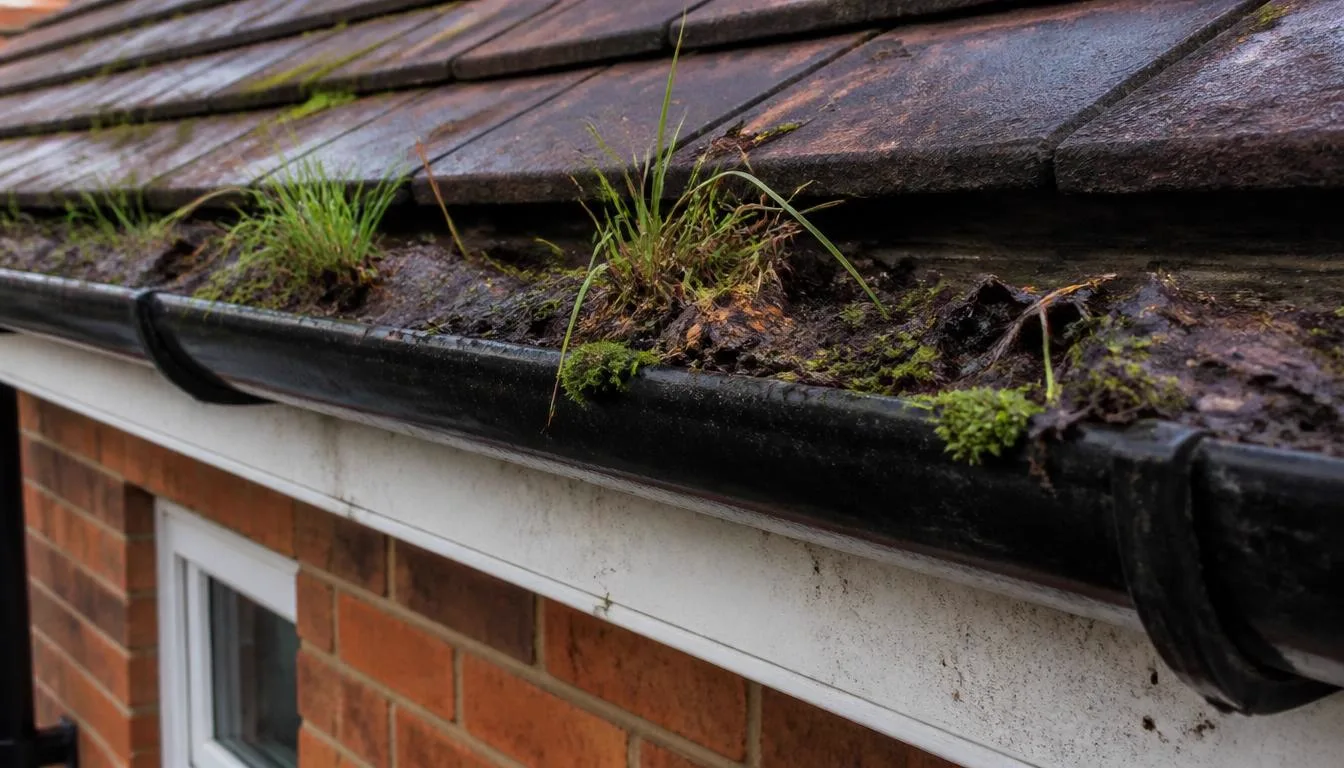
Water runs down the wall instead of down the pipe. A blocked gutter overflows at the point of blockage, and that water goes straight onto the brickwork below. Over a wet winter the wall never dries out. On a solid-wall Victorian property — which is most of the older housing stock here — that means damp appearing on the inside of the external wall, usually in an upstairs room, usually blamed on something else entirely.
The fascia board stays wet. The gutter is screwed into the fascia. A gutter full of wet, decaying leaves holds that water against the board continuously. On UPVC that's mostly a cleaning problem. On a painted timber fascia, it's how rot starts.
The weight pulls the gutter out of line. Wet leaves and silt are heavy. A fully blocked run sags at the middle, which breaks the fall towards the downpipe, which means it never drains properly again even once it's cleared. Then the joints start to leak. This is the most common reason a gutter that "just needs a clean" turns into a gutter that needs gutter repairs.
Things grow in it. Grass, moss and even small buddleia seedlings establish in the silt layer. Roots get into the joints. Once you can see green growth from the ground, the gutter has been blocked for a long time.
None of this is sudden. That's exactly why it gets missed — nothing dramatic happens in week one. The cost accumulates quietly over two or three winters and then presents as a damp problem or a replacement quote.
How professional gutter clearing is done
The method matters less to you than the result, but it's worth knowing what to expect and what to avoid.
Vacuum from the ground, not hands from a ladder. We use industrial gutter vacuum equipment on carbon poles, reaching the gutter line from the ground. The debris is pulled out and into the machine rather than scooped over the edge, which means it doesn't end up in your flower beds or down the side of the house.
Downpipes cleared and flushed, not just the gutter run. This is the step that gets skipped. A gutter can look perfectly clear from the ground while the downpipe entry is plugged with compacted silt. Clearing the run without checking the pipe leaves you with the same overflow and a clean-looking gutter, which is worse, because now you think it's sorted.
Before-and-after inspection. You can't see your own gutters. A camera on the pole means you get shown what was in there and what it looks like afterwards — and it's how anything genuinely wrong gets spotted while someone is already up there looking.
All gutter types. UPVC, cast iron, half-round, ogee, box gutters on extensions and conservatories. Cast iron on the older properties around here needs a bit more care — the joints are sealed with putty and mastic that are often a century old, so it's cleared gently rather than forced. If yours is already leaking or rusting, our guide to repairing or replacing cast iron guttering explains which faults usually need repair and when replacement is justified.
The one thing not to do
Don't go up a ladder yourself to clear your own gutters in autumn.
This is the single most common domestic accident of the season, and the reason is mechanical rather than careless: clearing a gutter means reaching sideways from a ladder with both hands occupied, on ground that is wet and often soft, while the ladder is resting against the very gutter you're about to pull debris out of. Falls from domestic ladders at roofline height cause serious injuries every year in the UK.
It also tends to damage the gutter. A ladder resting on a plastic gutter run — or on the fascia board behind it — is how brackets get bent and joints get sprung.
If it's a single-storey extension you can reach safely from a stable ladder on level ground, fair enough. Above that, it isn't a job worth doing yourself.
How often, realistically
- Under mature trees, or with plane trees on the street: twice a year — autumn and late spring.
- Average north London property, some tree cover: once a year, in the autumn window.
- Open plot, no overhanging trees: once every eighteen months to two years, though the downpipe entry still silts up and is worth checking annually.
The honest signal that you've left it too long: water visibly sheeting over the front edge during rain, staining or green streaking down the wall below a particular spot, or plants growing out of the gutter. Any of those means it's already been blocked for a while.
Do it in the same visit as the roofline
If we're already at the gutter line with the equipment set up, cleaning the outside face of the guttering and the fascia and soffit cleaning at the same time costs far less than a separate visit later.
It's also the natural pairing: the inside of the gutter is what causes the damage, the outside is what you actually see from the street. Clearing one and not the other leaves you with a functioning gutter that still looks filthy. We've written separately about the roofline and why green UPVC almost never needs replacing — the job everyone forgets — if that's the bit that's been bothering you.
Frequently asked questions
When is the best time to clean gutters in London?
Late September to mid-October, before sustained autumn rain arrives and ahead of peak leaf fall. Properties under heavy tree cover benefit from a second clear in late November once the trees are bare.
How often should gutters be cleaned?
Once a year for a typical north London property, and twice a year where mature trees overhang the roof or plane trees line the street. Newer properties on open plots can often go eighteen months to two years, though the downpipe entry is worth checking annually.
Can gutters be cleaned without ladders?
Yes. Industrial gutter vacuum equipment on extending poles clears gutters from the ground on properties up to three storeys, with no ladders resting against the building and no debris dropped into the garden.
What happens if you never clean your gutters?
Water overflows onto the external wall instead of draining away, and over successive wet winters this causes damp inside the property, particularly on solid-wall Victorian houses. The weight of wet debris also pulls gutter runs out of alignment, causing leaking joints and sagging that cleaning alone will not fix.
Are downpipes cleared as well as the gutters?
Yes. Downpipes are cleared and flushed as part of the service. A gutter run can look clear from the ground while the downpipe entry is plugged with compacted silt, which causes the same overflow.
Can cast iron gutters be cleaned?
Yes. Cast iron guttering is common on older north London properties and is cleared more gently than UPVC, because the joints are sealed with putty and mastic that may be very old. Failing joints or cracked sections are reported rather than worked around.
How much does gutter cleaning cost in north London?
It depends on the size of the property, the length of the gutter run, access and how long it has been since the last clear. A free, no-obligation quote is provided on request.
Gutter cleaning across north London
DP Window & Gutter Cleaning provides gutter cleaning across north London — Islington, Muswell Hill, Hampstead, Haringey, Enfield, Barnet and the surrounding areas. Vacuum clearing from the ground, downpipes flushed, before-and-after photos on every job.