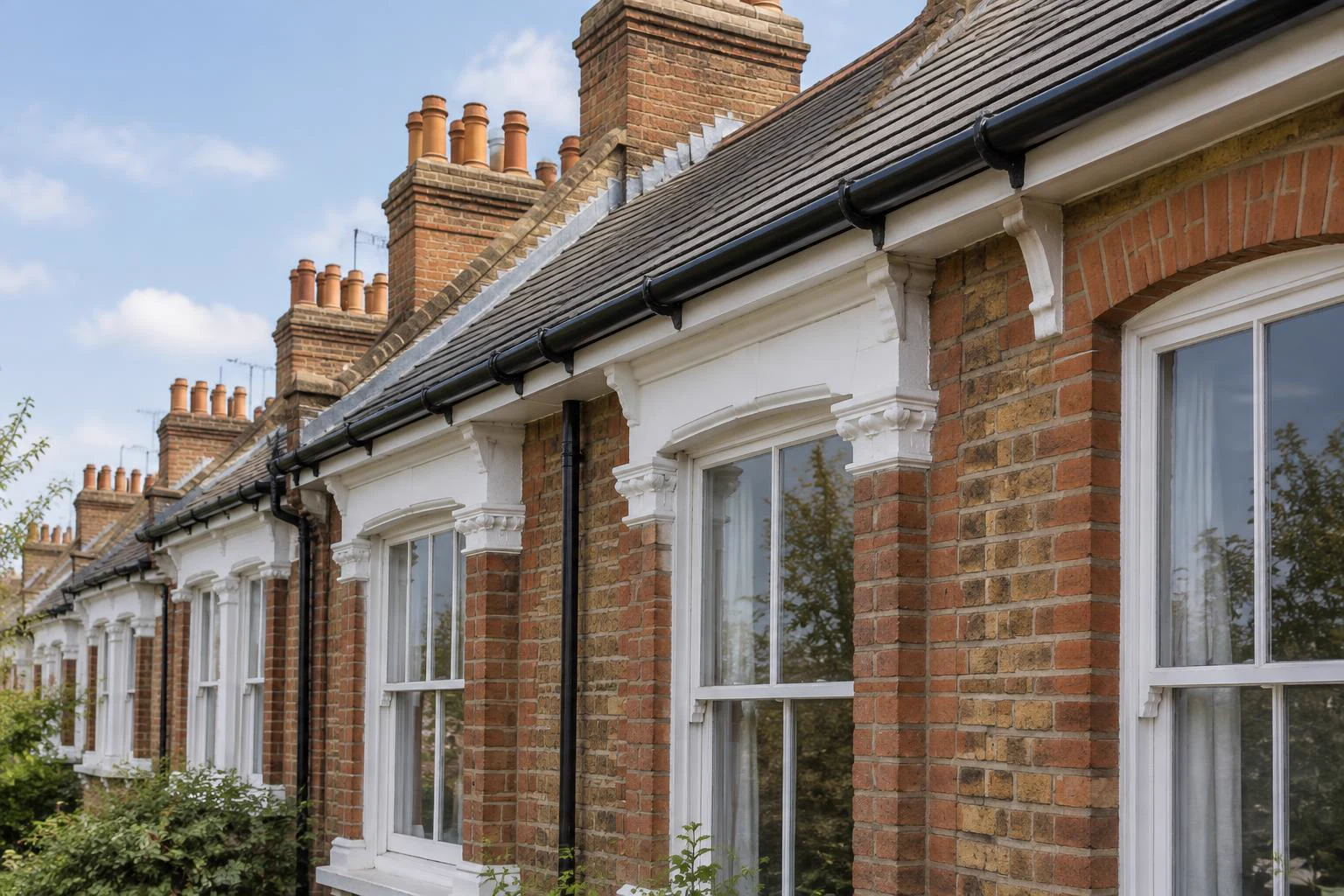
What goes wrong with cast iron gutters on London period homes, which faults are worth repairing, and why swapping to plastic is often the wrong call.
If you own a Victorian or Edwardian house in north London, there's a reasonable chance the guttering on it is older than everyone who has ever lived there.
Cast iron guttering was standard from the mid-1800s until UPVC took over in the 1970s. A lot of it is still up there, still working, still doing the job it was cast for. And when something finally goes wrong with it, the first quote most people get is for ripping the lot off and replacing it with plastic.
Sometimes that's right. Often it isn't.
Why cast iron is still up there after a century
Because it was made to last, and because it was made to be repaired.
Cast iron gutters were installed in sections — typically six-foot lengths — bolted together at overlapping joints and sealed with putty or mastic. Each section sits in its own bracket. That construction means a damaged length can be taken out and replaced on its own, and a failed joint can be stripped and resealed, without touching the rest of the run.
It's also structurally far stronger than plastic. Cast iron doesn't sag under the weight of wet leaves, doesn't distort in summer heat, and doesn't go brittle under UV. A ladder resting against it does not bend it. On the front elevation of a period house it also simply looks right — the deep half-round or ogee profile with visible brackets is part of what the building is supposed to look like, which is why conservation officers care about it.
The trade-off is that iron rusts, putty perishes, and paint eventually fails. Cast iron is not maintenance-free. It's maintenance-able, which is a different and better thing.
What actually goes wrong
Four faults, in rough order of how often we see them.
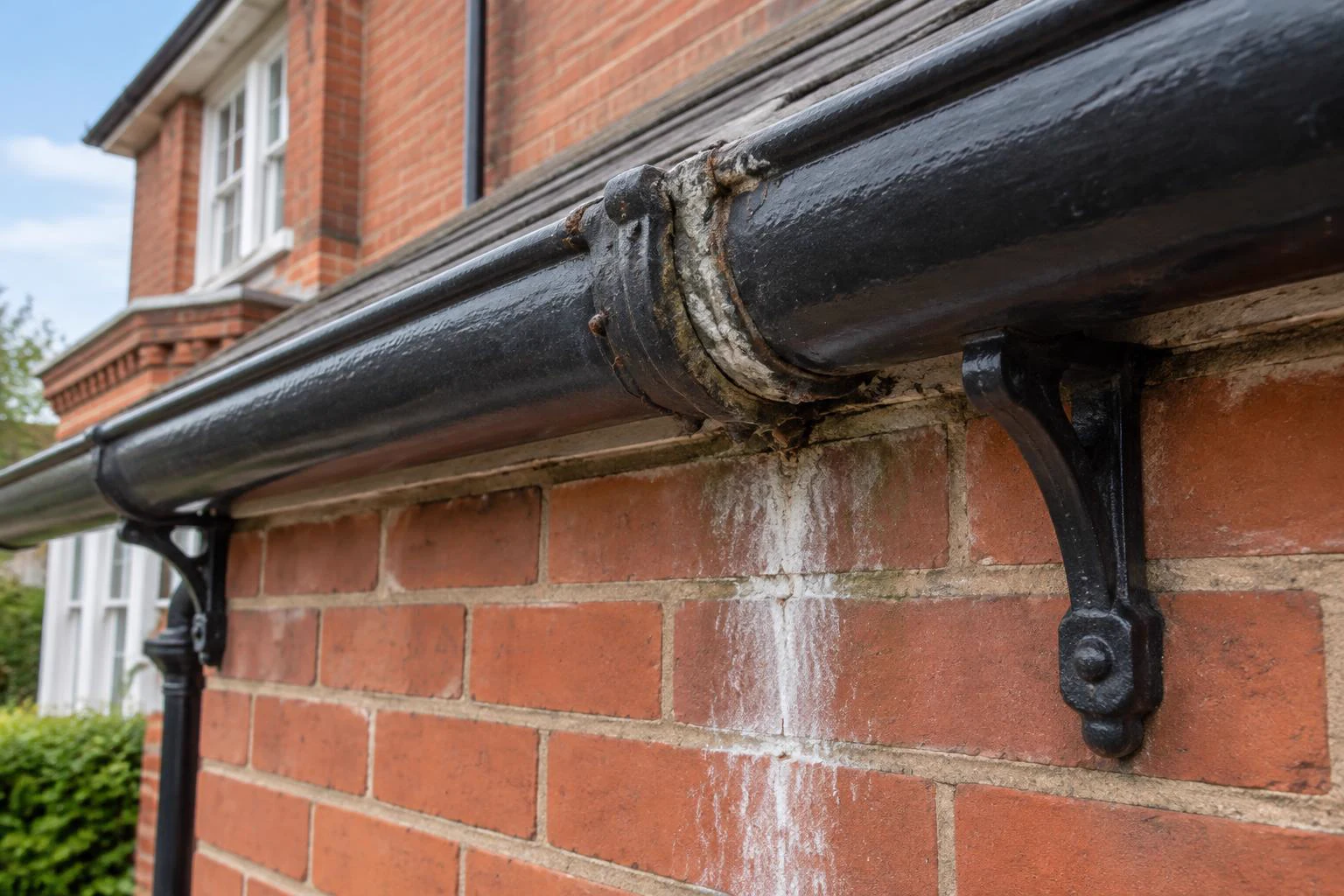
Failed joints. By far the most common. The putty or mastic at the overlap between two sections dries out, shrinks and cracks, and the joint starts to weep. You'll see a persistent drip in one spot during rain, and a staining streak down the brickwork below it. This is a repair, not a replacement — the joint is stripped back, cleaned and resealed.
Rust. Iron corrodes where the paint film has broken, and that usually starts on the inside of the gutter, where standing water and rotting leaves sit against the metal. This is the key thing: cast iron rusts from the inside out, so by the time you can see rust from the ground, the inside has been going for a long time. Surface rust is easily treated. Rust that has eaten through the base of the gutter is not, and that section needs replacing.
Broken or missing brackets. The fixings are screwed into the fascia or directly into the rafter feet. Timber behind them rots, screws pull out, and a section drops slightly — which breaks the fall towards the downpipe and causes standing water and overflow. Very repairable, and cheap if caught early.
Cracked sections. Cast iron is strong but brittle. It cracks from impact, from a ladder placed badly, or from ice expanding in a gutter that was blocked when it froze. A cracked length has to be replaced, but only that length.
Notice that three of those four are repairs, and the fourth is a partial replacement. That's the whole argument.
Repair or replace: the honest answer
Repair when: the run is structurally sound, the faults are joints, brackets or localised rust, and the profile is original to the building. This describes most of the cast iron guttering we see in north London.
Replace individual sections when: rust has perforated the base, or a length is cracked. Matching sections in the same profile are still readily available, and a replaced length can be painted to match so the run reads as continuous.
Replace the whole run when: multiple sections have perforated, brackets have failed along the length because the fascia timber behind has rotted, or the gutter has been over-painted and patched so many times that the profile has effectively been lost. This is a genuine outcome, just a much rarer one than the quotes suggest.
The reason so many quotes go straight to full replacement is not usually dishonesty. It's that pulling everything off and fitting plastic is faster, needs less skill, and is easier to price. Repairing cast iron is fiddly work that requires knowing what you're doing.
Should you swap cast iron for UPVC?
There's a reasonable case for it and a reasonable case against, and it depends on the building.
The case for plastic: it's cheaper up front, lighter, doesn't rust, and needs no painting. On a rear elevation nobody sees, or on a property that's already lost its original features, it's a perfectly sensible choice.
The case against: plastic sags under load and distorts in heat, it goes brittle and discolours after fifteen or twenty years, and the joints rely on rubber seals that perish. Cast iron that's looked after outlasts several plastic replacements. On a front elevation, deep plastic guttering on a period facade is immediately visible and does the building no favours — and on a listed building or in a conservation area it may not be permitted at all.
If you're in a conservation area, and much of Islington, Camden and Hampstead is, check before anyone removes anything. Replacing original cast iron with plastic on a street-facing elevation can require consent, and Article 4 directions in some north London boroughs remove the permitted-development rights you'd otherwise rely on. It's a quick call to the council's conservation team, and much cheaper than putting it back.
Keeping it alive: what actually matters
Cast iron fails from neglect far more often than from age. Three things keep it going.
Keep it clear. Standing water and rotting leaf mulch sitting against bare iron is what starts the rust, and a blocked gutter that freezes is what cracks sections. Annual clearing is not cosmetic maintenance on cast iron — it's the single most effective thing you can do to extend its life. Our guide to why autumn is the critical window covers the timing.
Keep it painted. The paint film is the only thing between the iron and the weather. Repaint when it starts to flake, not when the rust appears. The inside of the gutter matters more than the outside, and it's the part that never gets done.
Fix joints early. A weeping joint is a cheap repair. The same joint left for three winters has soaked the fascia timber behind it, which rots, which pulls the brackets out, which drops the run. That's when a £100 job becomes a £1,000 one.
How we work on cast iron
Cleared gently, from the ground, with vacuum equipment rather than by hand from a ladder — a ladder against century-old iron and perished putty is a way to make new problems. The joints are old and the seals are fragile, so debris is drawn out rather than scraped or forced.
Repairs are done on site where we can: joints stripped and resealed, brackets replaced, sections swapped. We carry parts on the van, so a lot of it gets sorted in the same visit rather than turning into a second appointment.
And if we look at your guttering and it genuinely has reached the end — if sections have perforated along the run — we'll tell you that. We'd rather say so than sell you a repair that fails next winter.
Frequently asked questions
Can cast iron guttering be repaired, or does it have to be replaced?
Most faults are repairable. Failed joints are stripped and resealed, broken brackets are replaced, and surface rust is treated. Only sections that have rusted through or cracked need replacing, and usually just those lengths rather than the whole run.
How long does cast iron guttering last?
Properly maintained — kept clear, kept painted, joints fixed when they start to weep — cast iron lasts a century or more, and a lot of what's on north London roofs is proof of that. Neglected, it can fail in thirty years.
Is cast iron guttering better than UPVC?
For durability and appearance on a period building, yes: it doesn't sag, distort in heat or go brittle under UV, and it can be repaired section by section. UPVC is cheaper, lighter and needs no painting, which makes it a sensible choice on rear elevations or modern buildings. The right answer depends on the property.
Do I need permission to replace cast iron gutters with plastic?
On a listed building, yes. In a conservation area, or where an Article 4 direction applies, replacing original guttering on a street-facing elevation may also require consent. Much of Islington, Camden and Hampstead falls into one of these categories, so check with the council's conservation team before work starts.
Why is my cast iron gutter leaking in one spot?
Almost always a failed joint. The putty or mastic seal between two sections has dried out and cracked. It's a straightforward repair and worth doing promptly, because the water running down behind it rots the fascia timber the brackets are fixed into.
Can you clean cast iron gutters safely?
Yes, with more care than UPVC. The joints are sealed with putty and mastic that may be a hundred years old, so debris is vacuumed out from the ground rather than scraped or forced. Anything found to be failing is reported rather than worked around.
What does cast iron gutter repair cost?
It depends entirely on what's wrong — resealing one joint and replacing a rusted-through section are very different jobs. We'll look at it and give you a free, no-obligation price, and we'll tell you which faults need doing now and which can wait.
Cast iron guttering across north London
We work on cast iron across the period housing stock of north London — the terraces of Islington and Hackney, the larger villas around Hampstead and Highgate, the streets of Camden and Stoke Newington. Cleared with vacuum equipment from the ground, repaired on site where possible, with photos so you can see what we found.
If the roofline is also looking tired while we're up there, our guide to fascia and soffit cleaning covers the boards behind the gutters — and gutter cleaning is the annual clear that keeps the iron alive in the first place.