When jet washing works, when it wrecks your paving, and how to clean a patio without a pressure washer. Practical guidance from a North London cleaning firm.
A patio can be cleaned safely with a pressure washer — but only on the right surface, at the right pressure, and with the right technique. Used carelessly, a jet wash will strip the sand from block paving joints, pit soft stone, and force water under slabs where it does slow damage you will not notice for months.
That is the part most guides leave out. This one covers when jet washing is the right answer, when it is not, and what to do instead.
Why patios go green and black
Three different things build up on a patio, and they do not all respond to the same treatment.
Algae and moss. The green film that makes paving slippery in autumn and winter. It grows wherever the surface stays damp — shaded corners, north-facing gardens, under trees. This is the easiest to remove and the fastest to come back.
General grime and weather staining. Traffic film, soil splash, leaf tannin and general London dirt. This is what a pressure wash is genuinely good at.
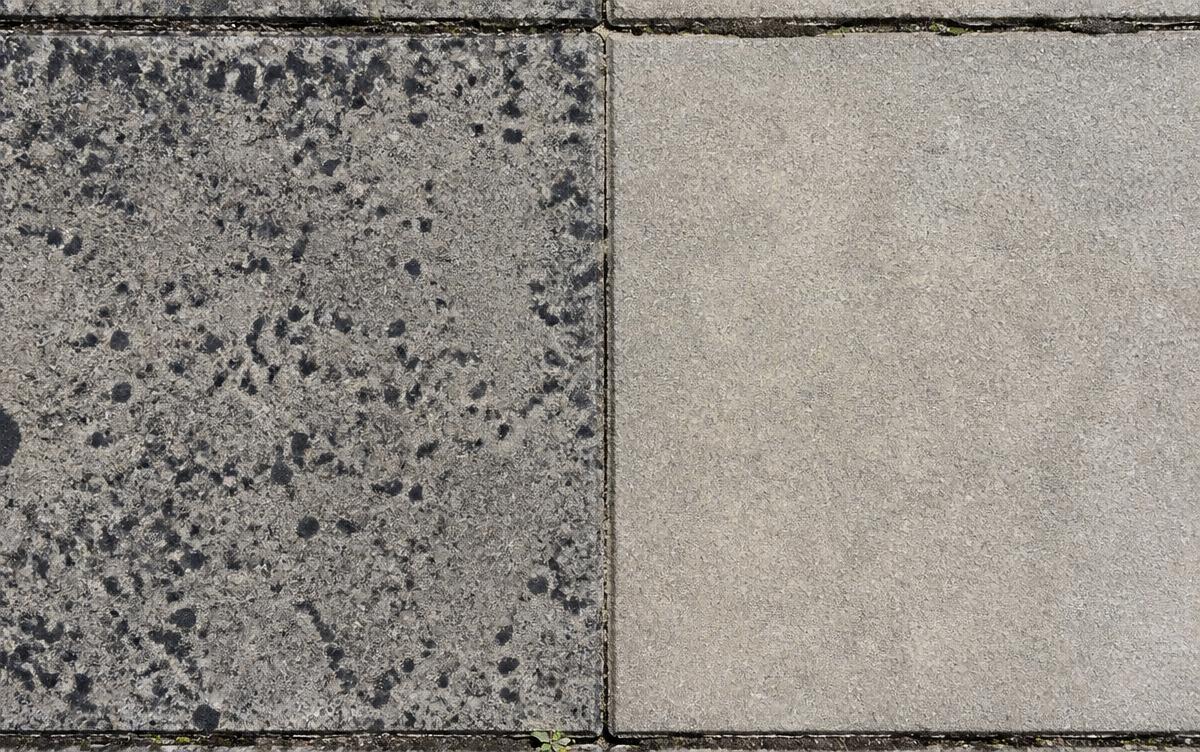
Black spots. Small, hard, black dots that look like tar or chewing gum and will not shift no matter how hard you wash. These are lichen, and they are the single most misunderstood patio problem. A pressure washer will not remove them — you can blast the surface until you damage it and the spots will still be there. Lichen has to be treated chemically and left to work, then washed off.
If you have been jet washing every year and the black spots are still there, that is why.
Can you jet wash a patio?
Yes — on the right surface. Pressure washing is well suited to concrete slabs, most modern porcelain, block paving in good condition, and hard-wearing natural stone such as granite.
Where it causes damage:
Indian sandstone and other soft stone. Sandstone is porous and comparatively soft. High pressure pits the surface and once pitted, it holds dirt worse than before — so the patio gets dirty faster every year. This is the most common expensive mistake on London patios, because sandstone is everywhere.
Block paving with worn joints. The sand between blocks is structural, not decorative. Blast it out and the blocks work loose, weeds get in faster, and re-sanding becomes a job in itself. Block paving can be washed, but the joints must be re-sanded afterwards — a step most people skip.
Old or crumbling pointing. If the mortar between slabs is already soft, pressure will remove what is left and water gets underneath. That leads to lifting slabs and, on a patio against the house, damp at the wall.
Anything near a house wall or airbrick. Water driven at pressure towards a wall can get past the damp course. On a patio that sits high against the brickwork, this is a real risk.
How to clean a patio without a pressure washer
For soft stone, worn block paving, or anyone who would rather not risk it, there is a straightforward method that works.
- Clear the surface. Sweep thoroughly and remove weeds from the joints.
- Apply a patio cleaner and let it work. Use a proprietary patio cleaner or a dilute soft-wash solution. The key is dwell time — leave it on the surface long enough to break down the growth rather than scrubbing immediately.
- Agitate with a stiff brush. A deck brush on a long handle. This is where the effort goes, and it is less effort than most people expect once the cleaner has done its part.
- Rinse with a garden hose, not a jet. Ordinary mains pressure is enough to carry the loosened material away.
- Treat the black spots separately. Lichen needs a dedicated treatment and usually a second application.
This approach is slower than jet washing but causes no damage, and on soft stone it produces a better result within a year because the surface stays sealed rather than pitted.
A note on bleach. Household bleach is widely recommended online and it does kill algae. It also runs off into borders and kills plants, can discolour natural stone permanently, and does nothing for lichen. A proper patio cleaner costs little more and does not carry those risks.
What about weeds in the joints?
Pulling weeds treats the symptom. Weeds grow in patio joints because there is enough organic debris in there for seeds to germinate — so the long-term answer is keeping the joints clear and properly filled.
After any patio clean, block paving joints should be topped up with kiln-dried sand. Slab joints with failing pointing need re-pointing, which is a separate job from cleaning and worth getting quoted for at the same time.
What professional patio cleaning costs
| Job | Typical cost |
|---|---|
| Small patio, up to 20m² | £90 – £150 |
| Standard patio, 20–40m² | £150 – £250 |
| Large patio or patio + path | £250 – £400 |
| Driveway, standard | £150 – £300 |
| Re-sanding block paving | Add £40 – £80 |
| Black spot / lichen treatment | Add £50 – £100 |
Prices vary with surface type, access and condition. A patio that has not been cleaned in five years takes considerably longer than one done annually — and soft stone that has been over-pressured in the past takes longer still, because pitted surfaces hold dirt more stubbornly.
Most north London domestic patios fall in the £150–£250 range.
When is the best time to clean a patio?
Late spring and early autumn are both good, for different reasons.
Spring clears the winter build-up and gets the space ready for the summer, which is when most people actually use it.
Early autumn is the more practical one. Clearing algae before the wet months means the patio goes into winter with a clean, sealed surface rather than a damp organic layer that grows all season. A patio cleaned in September is noticeably safer underfoot in January.
If you only do it once a year, do it in autumn.
A note on older properties and original paving
Many north London gardens have original York stone, Victorian tile, or reclaimed paving that has been down for a century or more. These surfaces are worth protecting.
Original York stone in particular is soft, and it is not replaceable in kind — reclaimed stone is expensive and modern substitutes never quite match. It should never be pressure washed at full power. Soft washing with a proper cleaner and a brush is slower, but it is the only method that leaves the surface intact.
The same applies to original Victorian path tiles, where high pressure lifts the glaze and destroys the pattern permanently.
If you are not certain what your paving is, that is itself a good reason to get someone to look at it before anyone points a lance at it.
Frequently asked questions
How do you clean a patio without a pressure washer?
Sweep the surface, apply a patio cleaner and leave it to dwell, agitate with a stiff deck brush, then rinse with a garden hose. Black lichen spots need a separate dedicated treatment. This method takes longer than jet washing but causes no damage to soft stone or joint sand.
Can you jet wash Indian sandstone?
Not at full pressure. Indian sandstone is porous and soft, and high pressure pits the surface permanently. Once pitted it holds dirt more readily, so the patio gets dirty faster each year. Sandstone should be soft washed with a cleaner and brush instead.
How do you remove black spots from a patio?
Black spots are lichen and cannot be pressure washed off. They need a dedicated lichen or black spot remover applied to the surface and left to work, often with a second application. Any amount of jet washing will fail to shift them.
How much does it cost to clean a patio in London?
Between £90 and £400 depending on size and surface. A standard north London domestic patio of 20 to 40 square metres typically costs £150 to £250. Re-sanding block paving adds £40 to £80.
Is it safe to jet wash block paving?
Yes, if the joints are re-sanded afterwards. The sand between blocks is structural, and pressure washing removes it. Skipping the re-sanding leaves blocks loose and lets weeds establish faster than before.
Does bleach damage a patio?
It can. Household bleach kills algae but may discolour natural stone permanently, and the run-off kills plants in nearby borders. It also has no effect on black lichen spots. A proprietary patio cleaner is safer and more effective.
How often should a patio be cleaned?
Once a year for most gardens. Early autumn is the most useful timing, because it clears algae before the wet months when paving becomes slippery.
Patio and driveway cleaning across north London
DP Window & Gutter Cleaning provides pressure washing service for patios, driveways and paths across north London — Islington, Muswell Hill, Haringey, Enfield, Barnet and the surrounding areas.
We match the method to the surface. Block paving, concrete and porcelain are pressure washed and re-sanded where needed. Soft stone, original York stone and Victorian tile are soft washed. Black spots are treated, not blasted. If we think jet washing would damage your paving, we will tell you and offer the alternative.